
Generation Save: your teen might be better with money than you are
New OnePay survey finds teens are saving 46% of what they earn right away, earning about $6,916 a year, and learning about money from family and online video far more than from school.
Share
Share
We set out to understand how financially independent today’s teens really are, from how much they earn and save to who’s making decisions like where they bank.
In a new survey of 2,000 U.S. parents of teens (ages 13 to 17), conducted by Talker Research for OnePay, nearly half of parents (46%) agreed their teen is more financially responsible than they are, including 21% who strongly agreed. More than a third (36%) said their teen saves more than they do.
The stereotype of the lazy, broke teenager may be out of date, and parents are the ones saying so.
Teens who earn money put almost half of it (46%) into savings right away. Their parents have noticed.
Asked what their teen does better, those parents said their teen thinks more carefully before buying (41%), waits and saves for big purchases (40%) and sticks to a budget more consistently (34%). Overall, 81% of parents call their teen financially responsible, and 89% of teens say the same about themselves.
Most teens didn’t pick their own bank, though. Two-thirds (67%) have a bank account, opened at age 14 on average, but only 12% chose it themselves. Moms made that call 52% of the time.
Teens are earning, mostly through outside traditional jobs
Nearly all teens (93%) have some way of earning money. Those who earn average $133 a week, or about $6,916 a year.
Most of it doesn't come from a traditional job. The top sources are allowance or chores (53%), side hustles (33%), part-time jobs (25%), caretaking such as babysitting or pet sitting (23%) and reselling (16%).
Reselling and side hustles put teens squarely in the thrift-flip and creator economy. For many of them, earning money looks less like clocking in and more like running something of their own.
Teens want in on the market, but few have a way in
Asked where they'd put $1,000, teens' top pick was a high-yield savings account (35%). Next came the stock market (22%) and crypto (20%), ahead of retirement accounts (16%). Parents leaned the other way, picking retirement accounts (24%) over crypto (16%).
Interest is running ahead of access. Only 9% of teens use any investing product today, and 6% have or use crypto. Some are already thinking long term: 10% are saving for retirement and 11% are saving to start a business.
Parents see the appetite. More than a quarter (28%) say their teen is more willing to take financial risks than they are. Taking bigger swings while young is a common approach, since there's more time to recover. But the conversation lags: 34% of parents talk about investing with their teen at least weekly, compared with 57% who talk about saving.
Teens' money classroom is home, then online video
Nine in 10 teens (91%) consume financial advice or educational content, about three hours a week. Family is the top source (60%), followed by YouTube (32%), friends (25%), TikTok (23%) and, fifth, school (22%). Teens of dads who took the survey were far more likely than teens of moms who took it to learn about money on YouTube (42% vs. 27%).
Much of that family teaching happens in passing. Most parents (57%) talk about saving with their teen at least weekly, most often during everyday moments (44%), at the kitchen table (41%) and in the car (35%).
Outside the home, finfluencers are doing more of the teaching than classrooms are. YouTube and TikTok each rank ahead of school as a source of money advice.
Teens and parents define success differently
Asked what they'd most like to have by 30, teens' top pick was a large salary (39%); only 25% chose zero debt. Parents flipped it, choosing zero debt and a high credit score (35% each) over a large salary (21%).
What it means for families
"Teens are already earning, saving and thinking hard about their financial futures. What most of them don't have yet is a real account that grows up with them," said Harsh Gupta, GM at OnePay. "Parents told us their teens are more responsible than they are. We think the right response is to give those teens the tools adults use, with parents right there alongside them."
Teens already understand saving. They don't need to be convinced; they need a place to do it, and they don't need a branch to bank well.
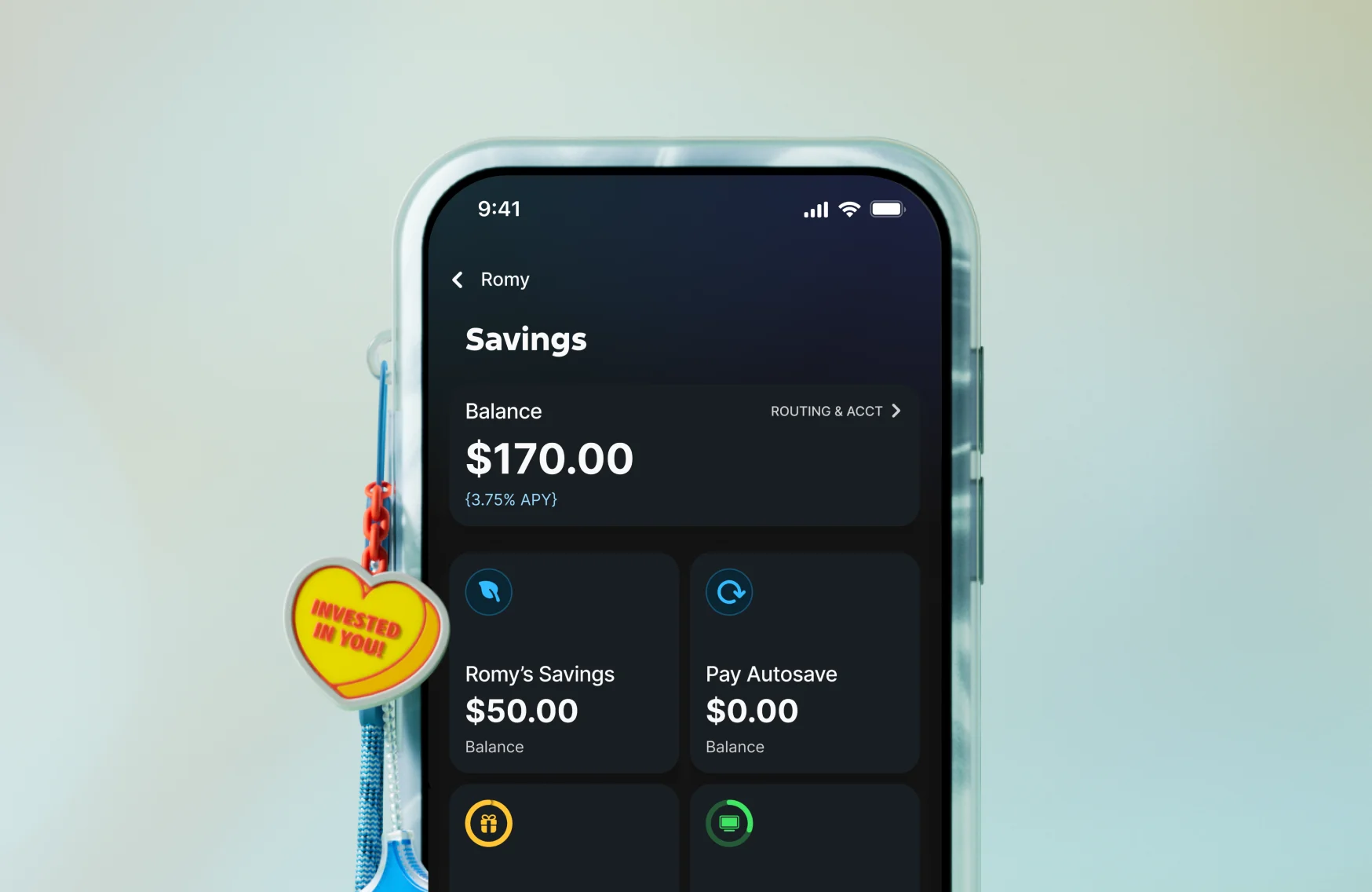
That's the idea behind banking built for teens through OnePay, which launched September 28 for teens ages 13–17 with no monthly or subscription fees. Parents can see their teen's accounts, manage controls, set allowances and get real-time alerts, all in the OnePay app. Money moves inside the family instantly and for free, so a teen's allowance or first paycheck has a real home.
For teens who want in on the market, parents can add them as an authorized user on their OnePay Invest account, so teens learn to invest with a parent involved. At 18, teens open their own Invest account and eligible investments transfer to it.
Teens can also start building credit history. Nothing is reported to the credit bureaus while they're under 18. At 18, OnePay reports eligible account history, so teens start adulthood with a credit file instead of a blank one. Their account moves with them, so the habits they've built don't reset on their birthday.
Family is already teens' first money teacher. OnePay doesn't replace those conversations; it gives parents and teens a shared place to practice what they talk about.
To get started, download the OnePay app and add your teen.
Research methodology
Talker Research surveyed 2,000 parents of teens ages 13 to 17 who have access to the internet; the survey was commissioned by OnePay and administered and conducted online by Talker Research between Sept. 23 to Sept. 28, 2026. A link to the questionnaire can be found here.
To view the complete methodology as part of AAPOR’s Transparency Initiative, please visit the Talker Research Process and Methodology page.