

Share
In this Article
Share
In 3.5 years, OnePay has become the platform used by millions of users and is one of the most used finance apps in the country. As we continue to grow, we want to start sharing more about how we build the products that millions of people depend on daily to achieve financial progress.
A Platform Built for the Future
When OnePay was founded, we wanted to give people a better way to manage their money. Our mission was simple: enable financial progress for all. We launched with a single product: a banking experience that made everyday money management easy, transparent, and fair. Today, we call it OnePay Cash.
We currently serve millions of customers and offer a broad range of financial products — debit and savings (OnePay Cash), credit cards, point-of-sale financing, investing in the stock market soon, buying and selling cryptocurrencies, credit-building and monitoring, remittance, earned wage access, and even wireless plans.
Our evolution from a single-product stack to a scalable, multi-product platform wasn’t just a matter of adding new features, it meant rethinking our entire architecture.
From a Single Product to a Platform
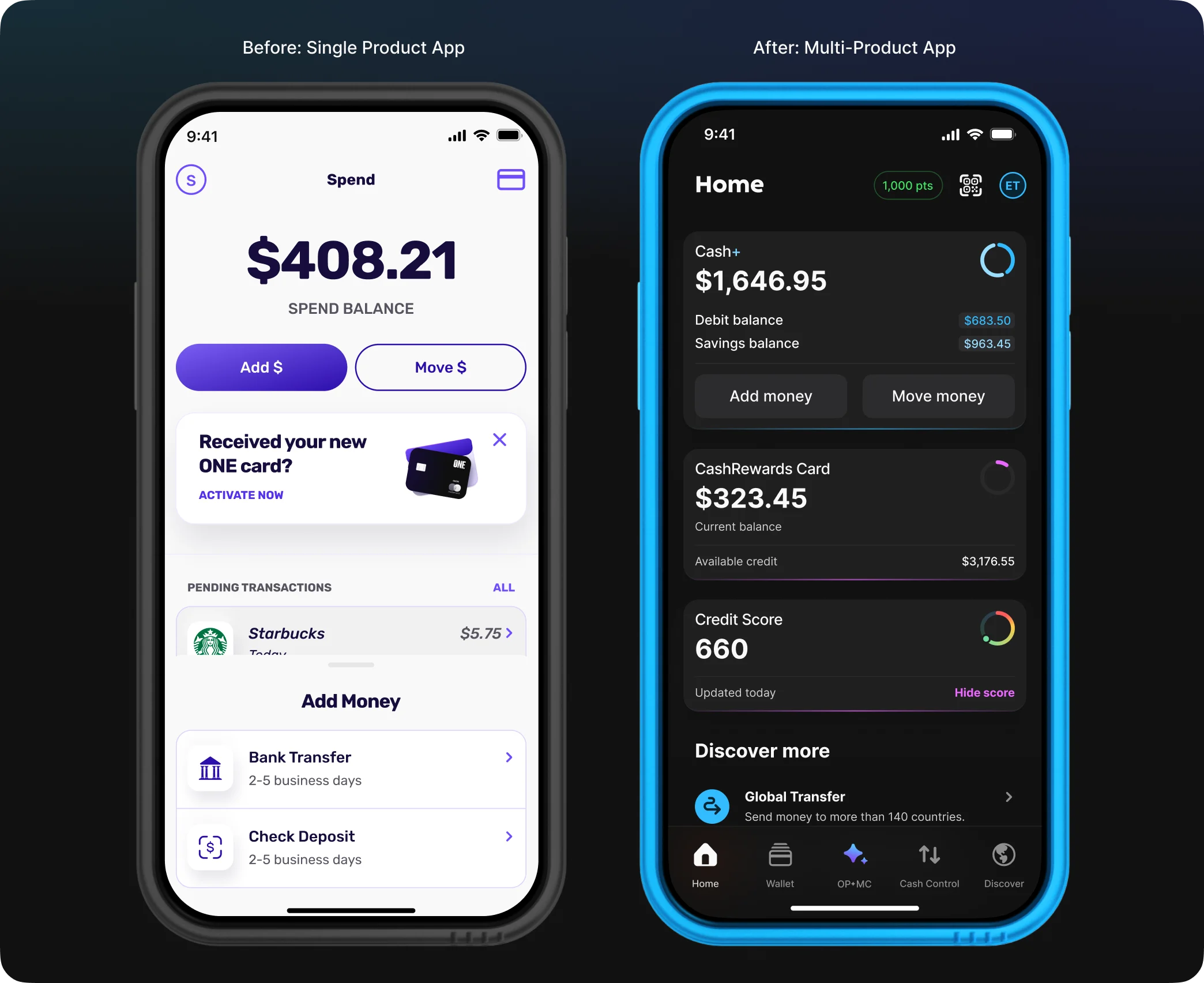
In the early days, we built fast. We had one core product — a digital banking experience — and a single stack powering it. But as we added new products, it became clear that what worked for one product couldn’t easily scale to many. Each new product introduced new complexities: different scale requirements, compliance needs, and data flows. The infrastructure that had been designed to move quickly started to show its limits. We quickly came to the realization that we weren't building "a product" anymore, we were building a platform.
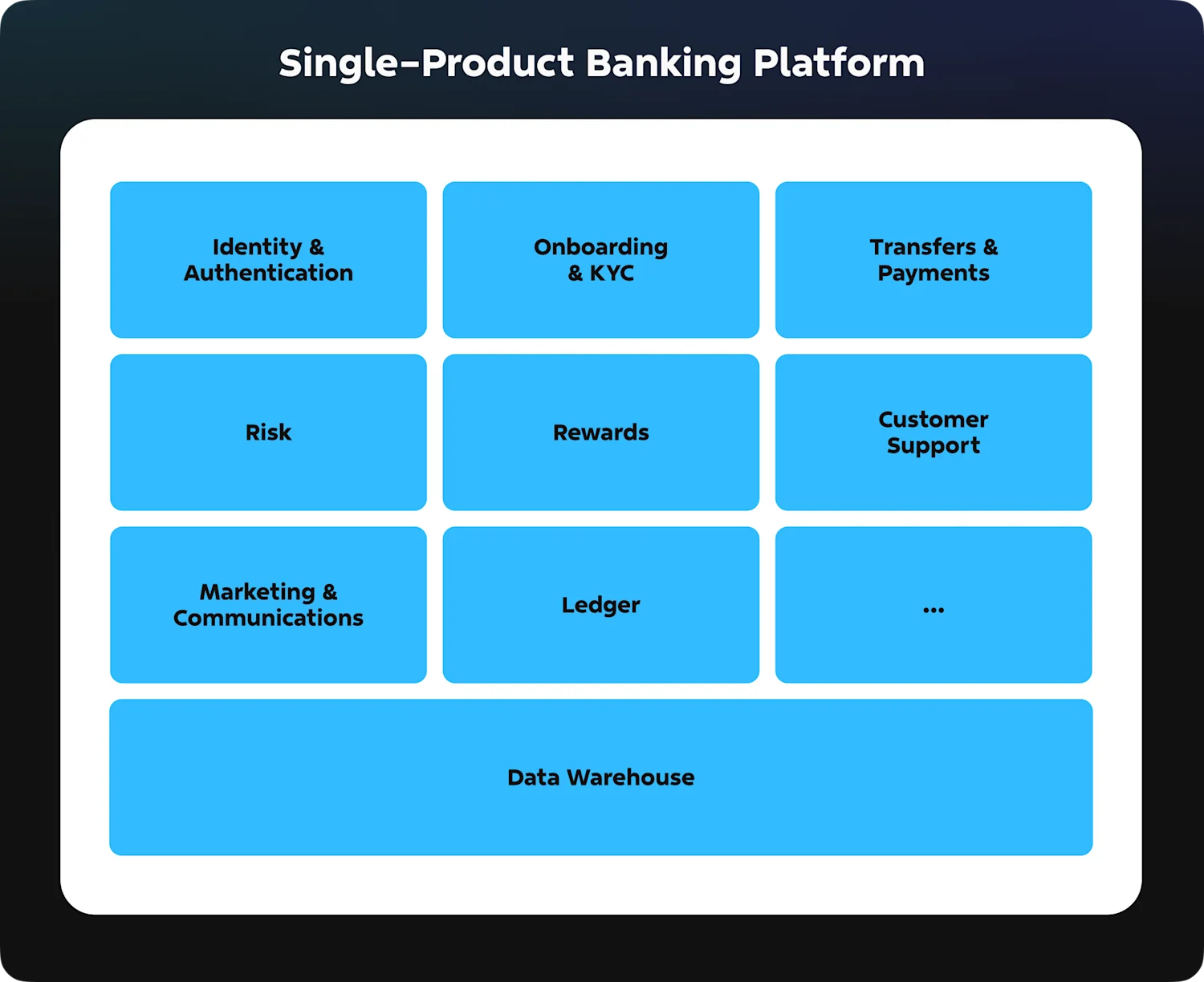
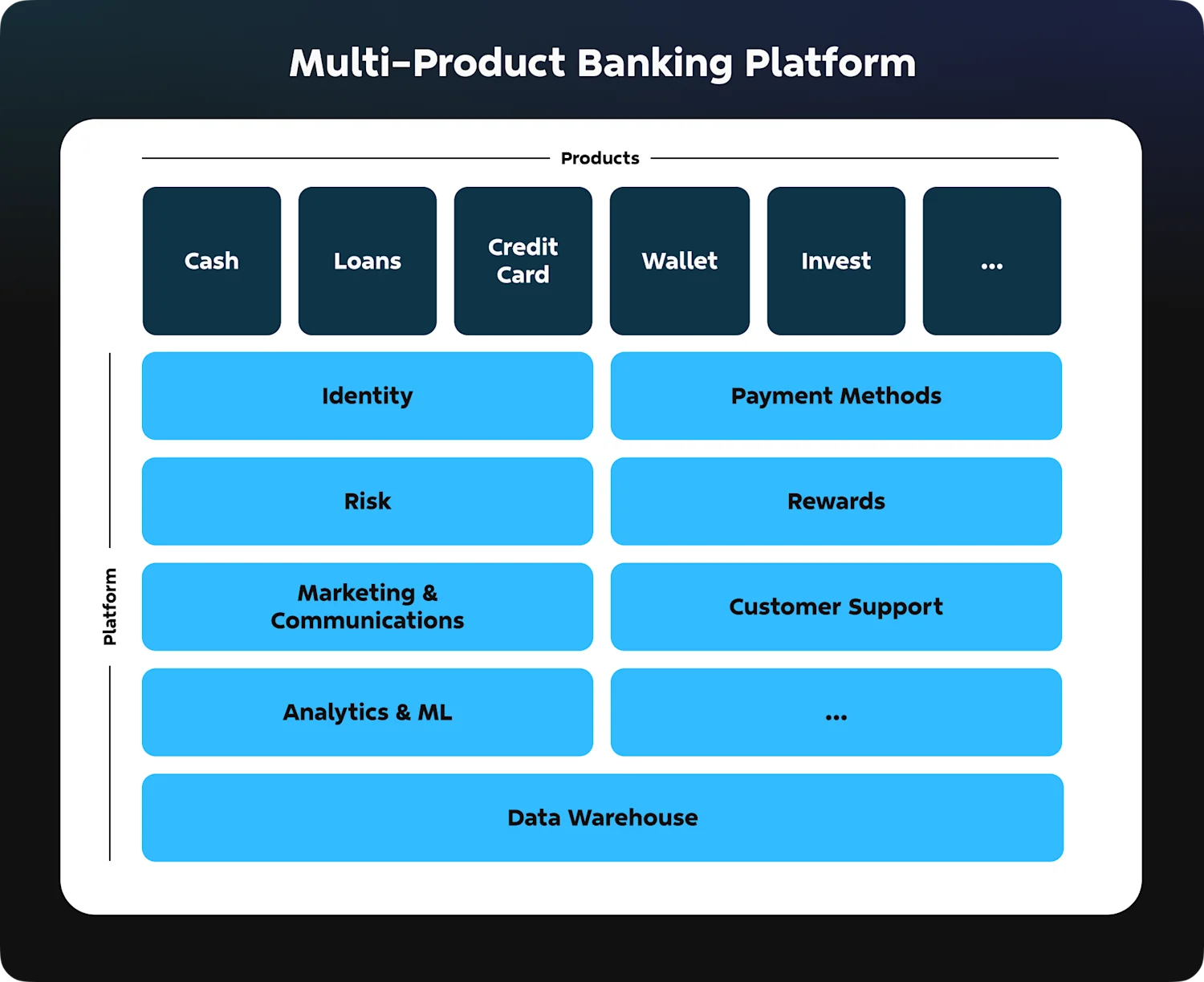
The shift from “a stack” to “a platform” happened when we saw the need to reuse foundational capabilities across multiple products. Think identity, payments, risk management, servicing and communications. These components power some of the most critical user experiences. A silo in the architecture can quickly manifest itself into a poor, disjointed user experience.
We began decoupling product logic from shared infrastructure. Instead of vertical silos, we created a horizontal foundation.
This change was technical and cultural. It required a mindset shift: every engineer becomes a platform engineer. It required a move from building features to building capabilities.
Designing an AI-native platform
We recognized the transformative potential of generative AI early on. Rather than embedding bespoke AI capabilities within individual products, we made a strategic decision to build AI into the platform. A reusable, horizontal AI stack, with a shared knowledge base and RAG, a self-service mechanism for managing policies, and a pluggable multi-LLM, multi-provider backend. This approach allows us to quickly test and use advanced LLMs across Support, Analytics, and in different products.
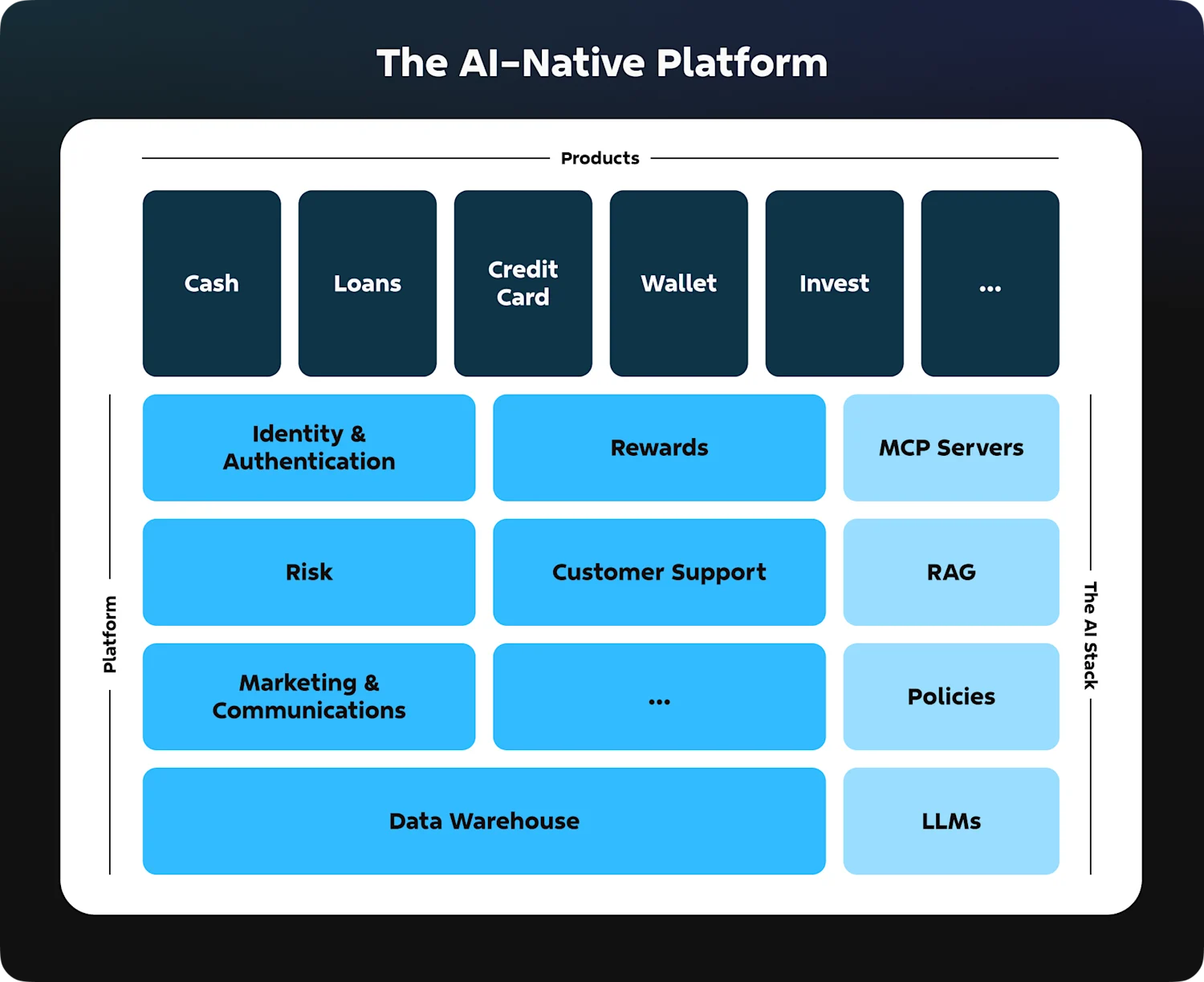
To serve millions of customers across diverse products, we follow a set of architectural principles that help maintain consistency and supportability across the platform:
Composable Architecture
Each product is a composition of shared and product-specific services. We’ve moved toward microservices and an event-driven model that allows independent deployment and scaling.Shared Core Services
Common capabilities like identity and KYC, rewards, risk and communications are standardized, scaled and managed centrally.AI-Native
Build AI capabilities into the platform, and fuel innovation across products. Manage the complexity of RAG building, policy tuning and model selection in one place.Unified Data Fabric
Real-time data pipelines unify event streams from all products into a data warehouse, enabling consistent analytics, fraud strategy, model training and personalization.Reliability and Observability
Every part of the system is fully instrumented. Our observability stack gives us real-time insight into latency, throughput, and anomalies across millions of transactions. The system is built with infrastructure redundancy to be able to withstand the most common inevitable failures gracefully.
These principles help accomplish our goal of creating a platform that is multi-product, efficient, scalable, resilient, and secure.
The platform advantage
Today, every new product we build is faster to ship, easier to maintain, and more scalable because it’s built on a shared foundation. This modular design has given us three major advantages:
Speed: Shared primitives mean new products go from idea to market faster. It took us 8 weeks to build recent offerings like OnePay Advance, Wireless, and other products.
Consistency: Unified experiences across products with one login, one balance view, one customer journey. A OnePay user can add a debit card to pay a loan, use it later to fund their bank account, or to pay for their wireless plan.
Resilience: Platform-level redundancy and observability make outages rare and recoveries fast. We typically ship > 1,600 releases to production per month, while maintaining system uptime.
Looking ahead
As we grow the OnePay platform, we’re investing in: (1) AI to create delightful customer experiences; (2) Internal productivity to help us ship even faster; and (3) Deeper observability across the full platform, powered by AI.
This series will cover how we’re building the foundation of a truly scalable fintech super app, from infrastructure and APIs to data and AI.